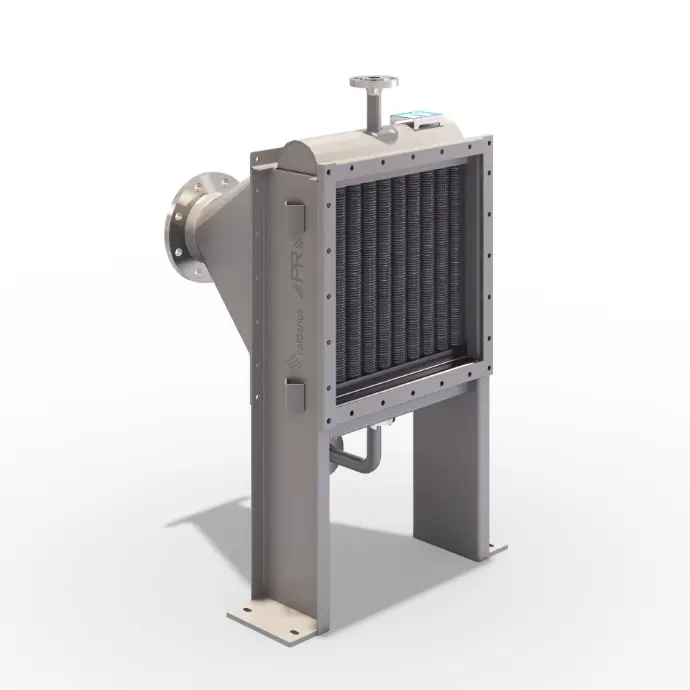
Monotube
Welded finned monotubes: maximum efficiency, reduced fouling, and exceptional mechanical strength. The high-performance heat exchanger for severe applications and sustainable energy savings.
Monotube finned heat exchangers offer a simple, robust, and economical design, suitable for fluids such as hot water, steam, or thermal oil. With a single fluid passage, they ensure very low pressure drop and excellent operational reliability.
Their finned surface optimises heat exchange while ensuring a high tolerance to fouling. A wide selection of materials for the tubes as well as for the fins provides great resistance to aggressive components in the gas flow. They find applications in air heating in ventilation, industrial air heaters, and drying processes. Compact and versatile, they represent an ideal solution for installations requiring efficiency and durability.
The main feature of the monotube is the mechanical independence of each tube and the possibility of having a significant spacing between the fins.
Monotube exchangers allow the use of materials that are not offered in the case of finned batteries or for processes that are incompatible with traditional finned batteries (high temperatures, aggressive or fouling fluids, ...).
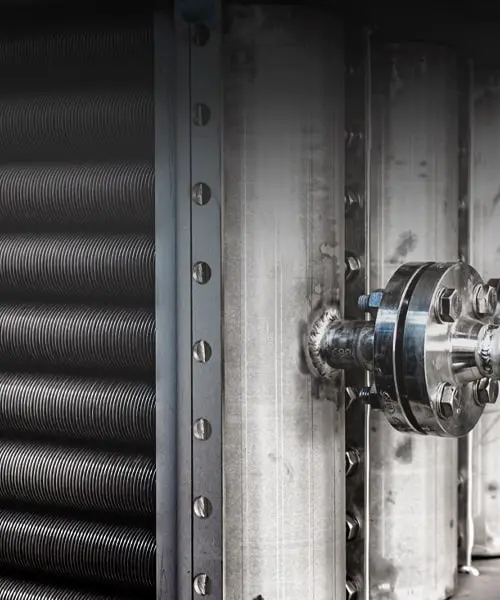
Dirty and contaminating environments
Monotubes allow for the use of a much wider fin pitch without losing structural efficiency. Thanks to a wide fin pitch and a spiral shape, they are better at resisting the accumulation of dust, fibres, soot, or coarse particles. They can be found in:
- Heat recovery from industrial flue gases or exhaust gases.
- Industrial drying (wood, agri-food) where the air is laden with moisture and particles.
- Air conditioning of large volumes (sports fields, workshops) where the air can be loaded.
High temperatures and thermal shocks
The construction (round tube with a fin attached, often welded or extruded) better withstands the differential expansion between the tube and the fin. They are used in:
- Industrial ovens and boilers.
- High-temperature gas-gas heat exchangers.
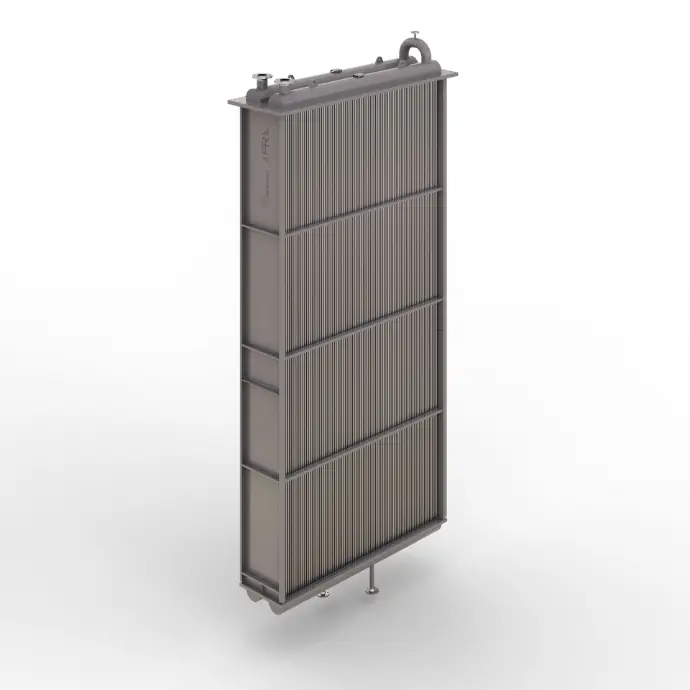
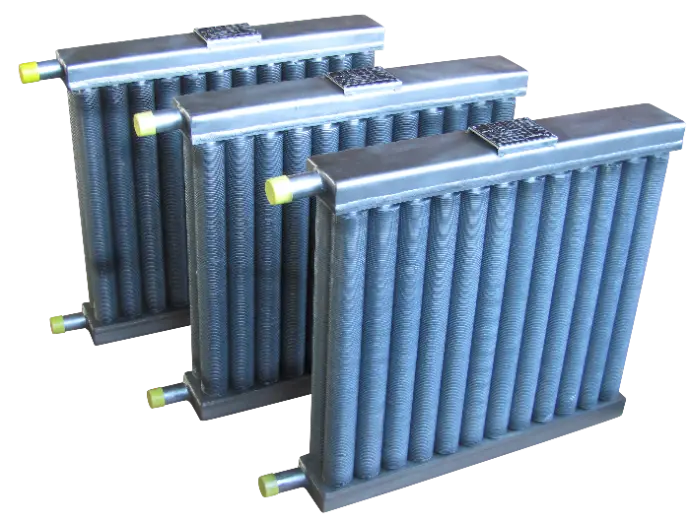
Frequent cleaning
The open structure allows for easier mechanical cleaning (brushing, high-pressure blowing) or chemical cleaning without damaging the heat exchanger.
Mechanical robustness and corrosion resistance
- Fin thickness: On a monotube, thicker fins can be used without excessively penalising weight or cost. This improves resistance to corrosion and erosion (for example, in marine or chemical environments).
- Structural independence: If a tube is damaged (leak, impact), it can sometimes be blocked or replaced without compromising the structural integrity of the entire exchanger.